Home ›
Case studies ›
Water ingress, Laeken
Water ingress in a flat in Laeken: a damaged drain found with a pipe camera
Flat
Water ingress
Thermal imaging
Camera inspection
In an apartment building in Laeken, a bedroom on the 1st floor was suffering from water ingress. A first theory pointed to a drain on the 5th floor. We tested it without breaking anything, combining a visual check, moisture readings, thermal imaging, fluorescent dye and a camera in the drain. Here is the process, what we found and our advice.
RESULT
A damaged drain located without opening anything up.
Location
Laeken
Building type
Flat on the 1st floor of a building
Problem
Water ingress in the rear bedroom
Methods
Moisture readings, thermal imaging, dye, camera, locator
Conclusion
Probable source, to be confirmed
The problem
A bedroom at the back of a 1st-floor flat was suffering from water ingress. The owner suspected a drain on the 5th floor. Right next to the affected area, a rear flat roof was another possible source.
The aim was twofold: test these theories without breaking anything unnecessarily, and draw no conclusion before checking on site. In this kind of situation, a stain on a ceiling or wall does not always show where the water gets in: it can follow a pipe, a slab or a joint before it appears.
The methods we used
1. Visual check of the rear bedroom, the neighbouring flat roof and the 5th-floor bathroom. In the bedroom, the radiator was off and the boiler pressure was correct.
2. Comparative moisture readings (see our damp diagnosis) on the walls and floor.
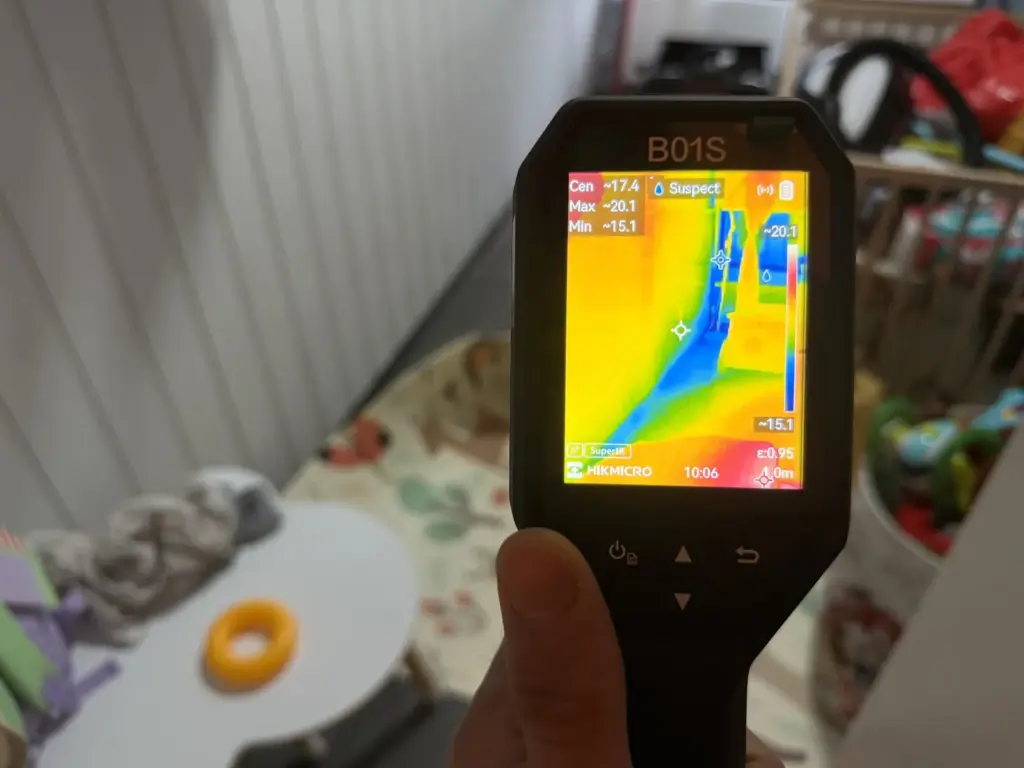
3. Thermal imaging of the bedroom, then with the radiator switched on to rule out the heating circuit.
4. Fluorescent dye, tested from the 2nd-floor kitchen sink, to see whether it shows up in the bedroom.
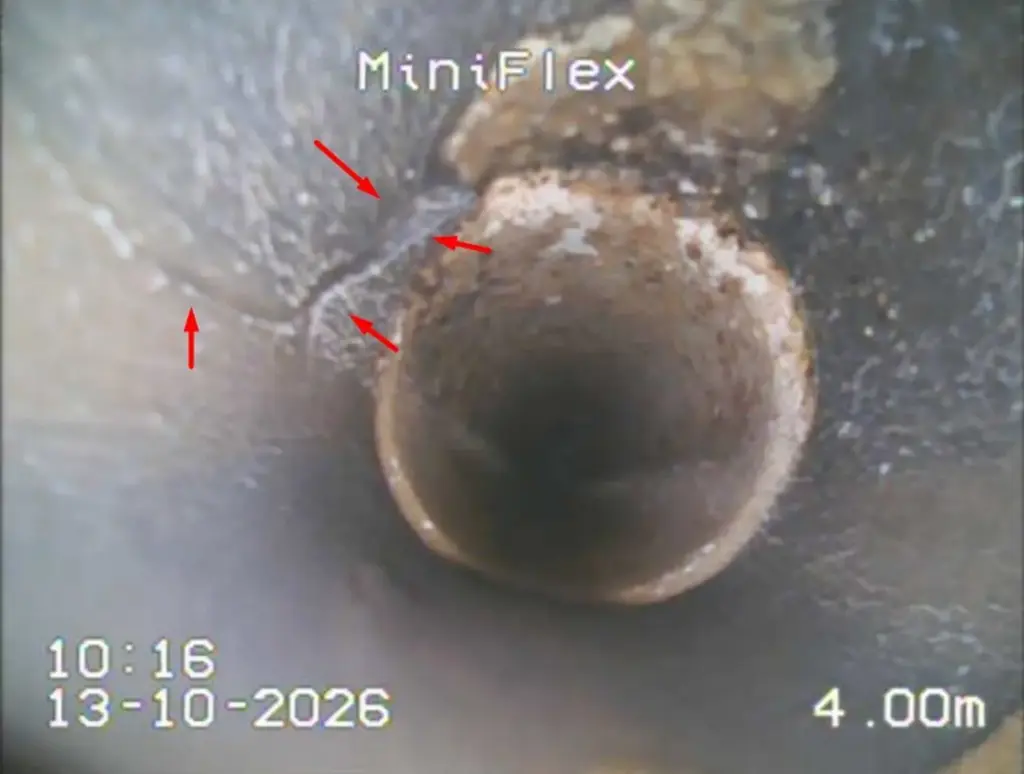
5. Camera inspection of the drain pipe reachable from that sink.
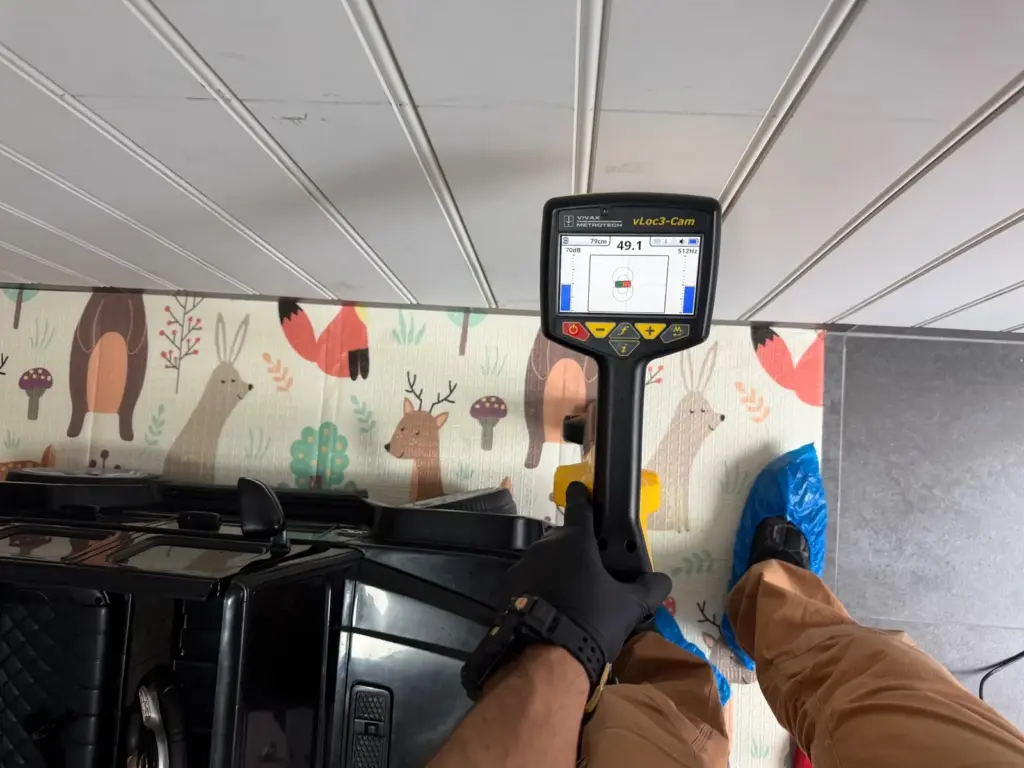
6. Locator to pinpoint the camera head, and so the possible defect.
What we found
In the bedroom. The relative readings are 27 on the wooden wall and 55 on the tiled floor; they are lower near the radiator, in the stairwell and in the adjoining area back to back with the wall. Thermal imaging shows a colder zone at the bottom of the wall, from the left corner to the rear wall facing the flat roof, and a more pronounced one under the window frame. The heating circuit shows no anomaly.
On the rear flat roof. Cracks, bituminous membrane coming away, defects at the flashing and sealing joints, and several openings or damaged spots in the facade: the rear part is in poor condition.
On the 5th floor. No visible anomaly at the bathtub.
In the 2nd-floor drain. The dye did not appear in the bedroom during the test. The camera does show several narrowed sections and irregularities, with an apparent break about 4 m from the access point. An occupant reports a serious blockage recently. The locator places the camera head at the break, in line with the 1st-floor bedroom (left side), at an indicative depth of about 75 cm.
Result and advice
Result. The 5th-floor theory was not borne out by the visual check. Two areas stand out: the damaged 2nd-floor drain and the rear flat roof, which is in poor condition. The exact route of the pipe still has to be confirmed before any opening, because the measured depth is only indicative.
Our advice
• Have the defective section of the drain repaired and the pipe sized up.
• Confirm the route of the pipe before any opening, so you open in the right place.
• Have the rear flat roof (membrane, flashing, joints) repaired by a roofer.
• After the works, take moisture readings again to check the drying.
Frequently asked questions
Does water ingress always come from the floor above?
No. Here, the 5th-floor bathroom showed no visible anomaly, while a 2nd-floor drain and a flat roof in poor condition did stand out. Several leads need testing before drawing a conclusion.
Can a drain be checked without breaking anything?
Often, yes. A camera passed through an access point such as a sink shows the condition of the pipe, and a locator pinpoints the camera head. You then know where to open up, if opening up proves necessary.